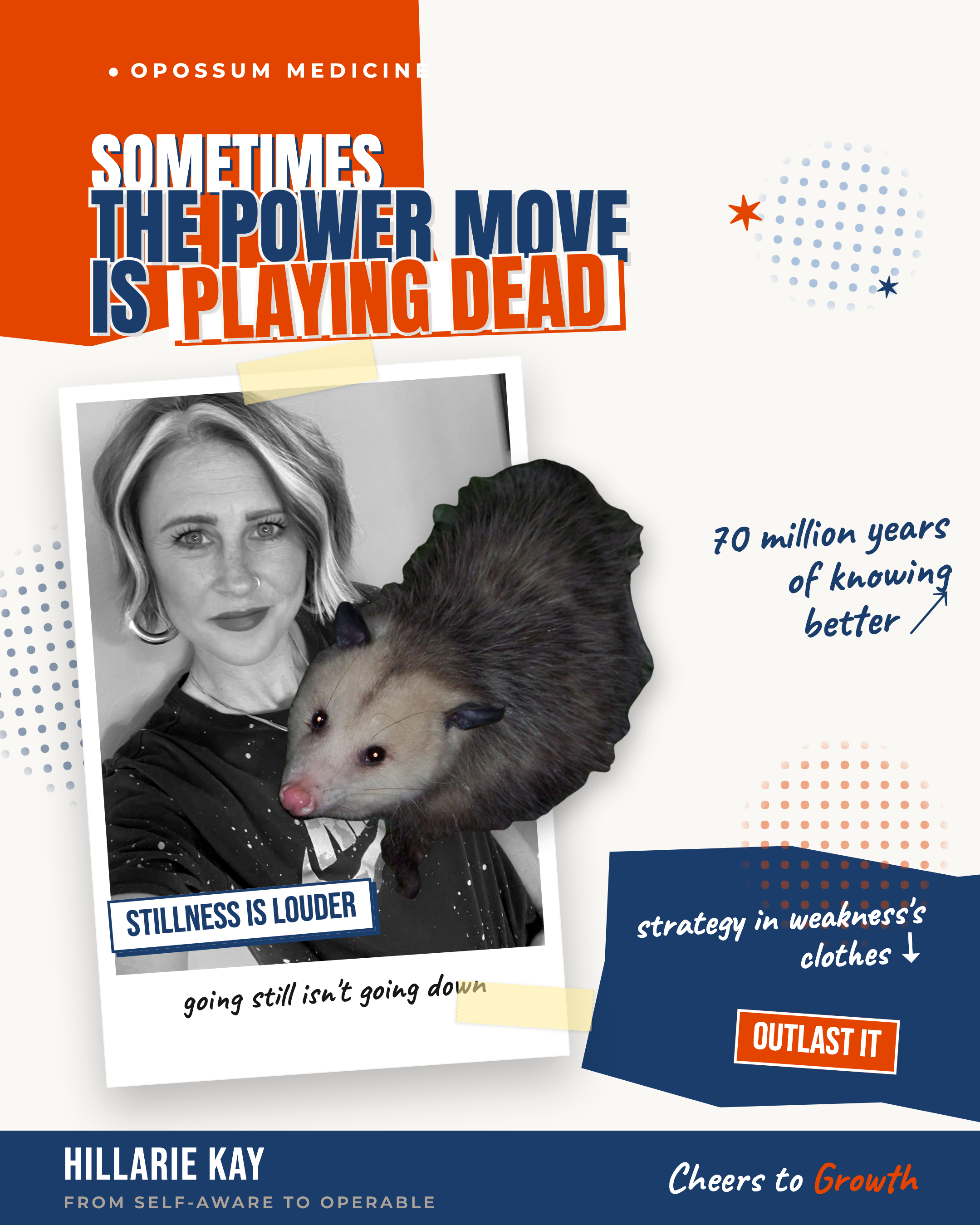
I have never been good at playing dead.
I'm the type who has things to do and people to see. When something comes at me — a threat, a slight, a problem with my name on it — every wire in my body says respond. Defend it. Fix it. Get out in front of it before it gets out in front of you. I was bred for performance, quite literally, and performance doesn't go still. Performance meets the moment.
So it's been a strange thing, lately, to feel myself going quiet instead.
Not the grief-quiet I've written about before. A different kind. The kind where you watch something land in your lap that absolutely deserves a reaction — and you choose, on purpose, not to give it one. Where the most useful thing you can do is go limp and let it pass over you. I keep catching myself doing it. And honestly? It feels like losing.
Then the universe dropped the metaphor right in my lap. The opossum.
I almost laughed. Of all the animals — the bear, the eagle, the wolf, something with teeth — the one that finds me is the one whose whole survival strategy is to flop over and pretend it's already dead. But the more I sat with it, the more I realized it wasn't a cute coincidence. It was precise.
Here's the thing about the opossum that I didn't know.
When it "plays dead," it isn't a performance. It's not a decision the animal calculates. Under enough threat, its body takes over and shuts the whole thing down — goes still, goes limp, stops the fight before the fight can be lost. It looks like surrender. It's actually the most sophisticated survival strategy in the field. The opossum has been around for seventy million years doing exactly this. It outlasted the dinosaurs by knowing which battles weren't worth its body.
And that's when it clicked into the thing I've spent my whole career on.
My work lives in the gap between what you intend and what people actually receive. Your intent is how you see the world. Your impact is how the world sees you. And I teach that under pressure, we don't lose our strengths — we lean harder into them. My strength is clarity. Decisiveness. Showing up and meeting the moment. Magnetic, when it's aligned.
But here's what I'd missed in my own wiring: when I react to every single thing that deserves a reaction, my intent — I'm defending what matters — is not what lands. What lands is: she's rattled. She can't let anything go. She's threatened. My advantage was turning into my distortion, and I couldn't see it, because from the inside it just felt like standing up for myself.
This was the discipline I never built. I spent years learning to see myself clearly. Years learning to be heard. Nobody taught me when to stop — when not reacting was the stronger read.
Because not reacting is a translation choice. Stillness is louder than the scramble. When you go quiet in the face of something that expected a fight, the room reads it instantly — and it doesn't read as defeat. It reads as she didn't need to. That's the impact I actually want. I just had to stop confusing the energy of the reaction with the strength of the position.
This isn't a workload problem. It never is. It's a wiring problem wearing a behavior problem's clothes.
And energy is the real currency here. Time is fixed, but energy is the wild card — and I have been spending mine on threats that were never going to matter in a month. The opossum doesn't engage the fight it would lose. It conserves itself for the life it's actually trying to live. That's not avoidance. That's equilibrium. Flow. Awareness. The wisdom to know that a thing demanding your reaction and a thing deserving your reaction are not the same thing.
So I'm learning, at this stage, to read the difference.
To ask, before I respond at all: Does this actually need my response — or does it just want it?
To let some things flop right over me and keep moving.
To trust that going still is not the same as going down.
I'm never going to be naturally good at it, because that's my wiring. But I'm starting to understand why the metaphor found me now, in this exact season. Some seasons are for meeting the moment head-on. And some are for playing dead — long enough for the threat to lose interest, and for you to keep the energy you were about to waste proving a point nobody asked you to prove.
So here's the question I'm sitting with, and I'll hand it to you too:
— Hillarie Kay